

CMS Just Answered the Question ACOs Have Been Asking for Three Years: What Do We Do About the TINs That Can't Report?
CY 2027 PFS Proposed Rule (CMS-1848-P) and what the Shared Savings Program proposals mean for ambulatory practices
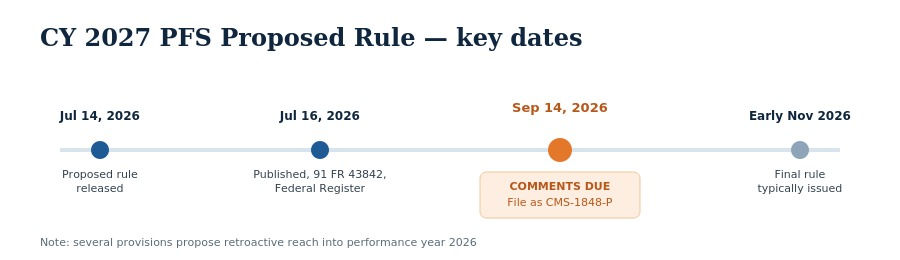
Comments due September 14, 2026
If you run quality for a Shared Savings Program ACO, you have almost certainly had this conversation: an ACO participant TIN is a specialty practice. Its EHR is certified for its specialty. It does not support breast cancer screening or depression screening follow-up. And yet its patients sit in your denominators, dragging you toward the 75% data completeness cliff at 42 CFR 414.1340.
Under current policy, that is your problem to solve.
In the CY 2027 Physician Fee Schedule proposed rule, released July 14 and published in the Federal Register on July 16, 2026, CMS proposes to make it less so.
The headline for anyone chasing data completeness: a 95% floor with TIN-level exclusions
CMS proposes that, for performance years beginning on or after January 1, 2026 an ACO could exclude one or more ACO participant TINs from its eCQM / MIPS CQM / Medicare CQM / Medicare eCQM submission on a per-measure basis. However, certain conditions need to be met. The conditions CMS names include:
Unforeseen circumstances outside the ACO's control, such as the unexpected closure of a practice billing under an ACO participant TIN
An ACO participant TIN whose CEHRT is intended for specialty use and does not support the measures in the APP Plus set
Other circumstances as determined by CMS
The guardrail: the ACO must still report on participant TINs representing at least 95% of its assigned beneficiaries before measure specifications are applied.
And the requirement that does not go away: for every measure the ACO does submit, it must still hit the MIPS data completeness threshold of at least 75% of the APM Entity's applicable beneficiaries meeting the denominator criteria.

Read those two together, because the operational implication is specific. This is not relief from data completeness. It is permission to draw a smaller, cleaner circle around the population you are held to — and then still perform inside it. An ACO that cannot identify, at the TIN level, which of its participants are specialty-only, what share of assigned beneficiaries each represents, and whether the remainder still clears 95%, cannot use this provision at all.
That is a data governance problem before it is a reporting problem. Most ACOs we work with do not currently have that inventory in a form they could defend in an audit.
Key takeaways
Exclusions apply per-measure, per-TIN but not at the whole-ACO level.
The proposed reach is retroactive to PY 2026 performance, not just PY 2027.
The 75% data completeness threshold still applies to whatever the ACO does submit.
Using this provision requires a defensible, audit-ready TIN inventory today.
A fourth collection type: Medicare eCQMs
For PY 2027 and subsequent years, CMS proposes to establish Medicare eCQMs as a new collection type for ACOs reporting APP Plus. A Medicare eCQM is essentially an eCQM from the APP Plus set, following eCQM specifications, but reported only on the ACO's assigned beneficiaries rather than the all-payer/all-patient population. This comes with a distinct identifier to mark the submission.
CMS is explicit about why: this is a bridge for ACOs that want to report eCQMs but cannot operationally aggregate all-payer data across disparate EHRs.
There is a real trade-off attached, and it is easy to miss
Medicare eCQMs would be scored on flat benchmarks beginning with the CY 2027 performance period / 2029 payment year.
ACOs choosing Medicare eCQMs would not be eligible for the eCQM/MIPS reporting incentive or the Complex Organization Adjustment.

For an ACO reporting five measures, the Complex Organization Adjustment alone can be worth up to 10% of total available measure achievement points. Giving that up to solve an aggregation problem is a defensible choice. However, it should be a calculated choice, not a default one. For PY 2027, CMS proposes ACOs could report the five Medicare eCQMs, or any combination of eCQMs / MIPS CQMs / Medicare CQMs / Medicare eCQMs.
Our read: ACOs that can genuinely aggregate all-payer data should stay on true eCQMs and keep the incentive and the adjustment. Medicare eCQMs are a floor, not a target.
Key takeaways
Medicare eCQMs solve an aggregation problem, not a performance problem.
The trade-off is real: flat benchmarks, no incentive, no Complex Org. Adjustment.
Model this against true eCQMs with actual denominators before defaulting to it.
MIPS CQMs get a reprieve
Under current policy, the MIPS CQM collection type sunsets for ACOs after PY 2026. CMS proposes to extend MIPS CQM availability for PY 2027 and beyond, and to extend the associated reporting incentive along with it. This is the one that lets an ACO meet the quality performance standard and share in savings at the maximum rate for its track, and, for ENHANCED track ACOs, avoid maximum shared losses.
If you were building a 2027 migration plan around a hard MIPS CQM cutoff, pause it. Do not, however, cancel it. This is a proposal, and CMS is transparent that the extension exists to let ACOs redirect effort toward digital quality measurement rather than toward another collection-type conversion.
APP Plus Shrinks to eight measures
CMS proposes to remove Initiation and Engagement of Substance Use Disorder Treatment (Q305) and Adult Immunization Status (Q493) from APP Plus, citing operational challenges and the resources ACOs are already devoting to digital quality measurement. Beginning PY 2027, APP Plus would hold eight measures: five ACO-reported (Q001 diabetes glycemic status, Q112 breast cancer screening, Q113 colorectal cancer screening, Q134 depression screening and follow-up, Q236 controlling high blood pressure), two administrative claims measures (Q479 HWR, Q484 multiple chronic conditions admissions), and CAHPS for MIPS.

CMS also proposes flat benchmarks for all Medicare CQM measures for PY 2027 and beyond, and for Q001, Q134, and Q236 reported via Medicare CQMs beginning in PY 2026.
CEHRT use requirements get rewritten
This one deserves more attention than it is getting. CMS proposes to sunset the requirement that ACOs report all MIPS Promoting Interoperability measures, replacing it for PY 2027 onward with a choice of one of three activities:

Completely report at least one of the five ACO-reported APP Plus measures through the eCQM or
Medicare eCQM collection type; Use CEHRT to support complete reporting of at least one of those five measures and attest to using data from an HL7® FHIR®-based API to support quality measurement via a certified Health IT Module; or
Attest to one of a set of ACO-specific CEHRT use metrics (e-prescribing, bidirectional HIE, or provider-to-patient exchange), with TIN-level exclusions available without a request to CMS.
Option 1 is worth sitting with. An ACO that reports even one measure as a true eCQM satisfies its entire CEHRT use obligation. For ACOs already on the eCQM path, a compliance burden simply evaporates. For ACOs that are not, the arithmetic just got more interesting.
ACOs electing option 3 would need to retain documentation of excluded TINs and produce it on audit, and would publicly report which activity they elected.
What we'd do between now and September 14
Build the TIN-level inventory now. For each ACO participant TIN: assigned beneficiary count and share, EHR product and certification scope, and whether it can support each of the five APP Plus measures. Without this you cannot evaluate the 95% exclusion, and if it is finalized retroactive to PY 2026, you will want it before the PY 2026 submission window, not after.
Model Medicare eCQMs against true eCQMs with your actual denominators, including the value of the Complex Organization Adjustment and the reporting incentive you would forfeit.
Decide your CEHRT use pathway. If you can report one measure as an eCQM, option 1 is the cheapest compliance answer on the table.
Comment. File code CMS-1848-P at regulations.gov. The 95% threshold, the definition of "specialty use" CEHRT, and the retroactive PY 2026 application are all places where operational detail written now saves rework later.
Why ReportingMD is watching this one closely
We have been doing population health and quality reporting work with CMS since 2007. That's twenty-five years in population health, and we've held a seat at the table for most of the program architecture that ACOs live inside today.
We were part of the group that helped wire-frame MIPS. We built one of the first bidirectional interfaces for MIPS submission, because we did not think a one-way file drop was a real answer for practices that needed to act on their data during the year rather than read about it afterward. And we began working with CMS on eCQMs while they were still in development, starting in 2011.
That history is the reason this particular proposed rule reads clearly to us. The TIN exclusion provision, the Medicare eCQM collection type, and the FHIR-based CEHRT attestation are all the same problem viewed from three angles: aggregating clinically valid, all-payer data across practices that never intended to share a denominator. That is the problem we have been building for since before it had a name in regulation.
We are an eCQM-certified vendor serving ambulatory practices. If you are trying to work out what these proposals mean for your ACO's PY 2026 submission or your PY 2027 strategy, we would welcome the conversation.
Not sure where your ACO stands on the 95% floor?
Talk to our team about building a defensible TIN-level inventory before the comment window closes.
This post summarizes proposals in CMS-1848-P, published at 91 FR 43842 on July 16, 2026. Proposals are not final policy and may change in the final rule, typically issued in early November. Nothing here is legal or compliance advice.


Comments